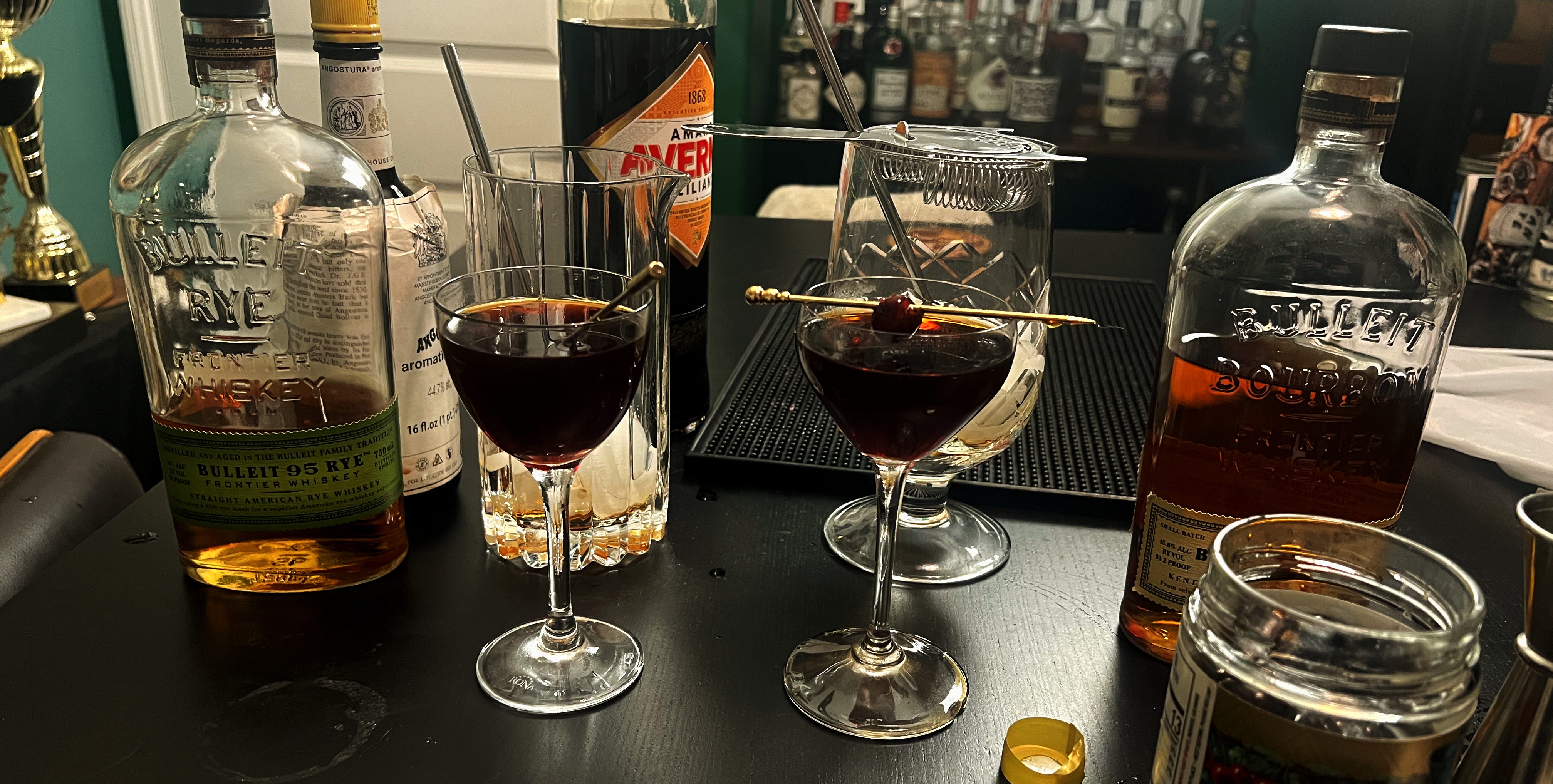
Black Manhattan
Like a Manhattan, but even more so.

At a glance:
Year Created: 2005
Inventor: Todd Smith
Ingredients: American Whiskey, Averna, Bitters
Cocktail Family: Manhattan
The very existence of the Black Manhattan is astounding to me. Subbing out sweet vermouth with Averna? To be clear, sweet vermouth and Averna taste almost nothing alike, and yet, not only does the drink work, it still somehow tastes like a Manhattan. It’s as if you were making a Mimosa, but instead of orange juice, you say to yourself “orange juice has some sweetness and some acidity, and you know what else does? Dr. Pepper.” and then you make a “Black Mimosa” with Champagne and Dr. Pepper and it’s delicious and everyone calls you a genius. Incredible.
The Story
The Black Manhattan is an unusual drink, unique among cocktails in the modern era in that it’s not a recipe so much as an idea.
I mean, it’s definitely a recipe, but let me explain: the Black Manhattan is a Manhattan in which the sweet vermouth is replaced by the bittersweet Italian liqueur, Averna. That’s the idea. And the reason that’s unusual — the reason for the drink’s aforementioned uniqueness — is that the recipe is pinned to our idea of a Manhattan, so therefore it has evolved over the years as our understanding of the Manhattan itself has evolved. It is the only modern classic that I know of that has not just tweaked specs but actually changed base spirits from what was originally intended. Part of the reason you’ll find so many slightly different recipes on the internet for the Black Manhattan is that different people have checked in on it in different phases of its evolution. Recipes don’t really do that. It’s evolved like an idea.
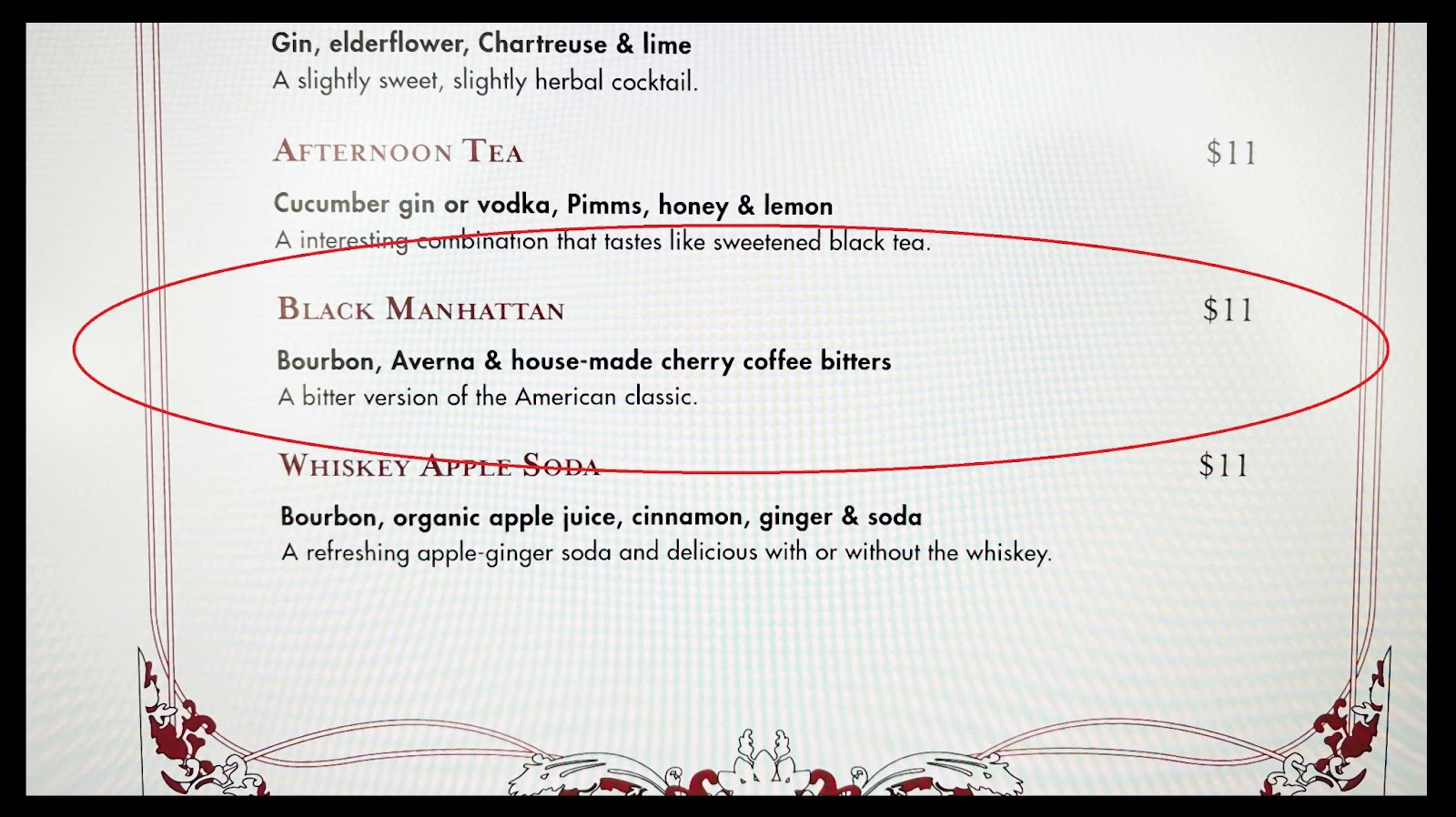
In 2005, Todd Smith was working at a restaurant in San Francisco called Cortez, “drinking and trying to find as much amaro as I could at the time,” he later said, and trying out cocktails with them. Somewhere in those liquid travels he came upon Averna, which he subbed in for the sweet vermouth in a Manhattan and, lo and behold, it worked. I don’t know if he put it on the menu at Cortez (which closed 16 years ago), but in any case, it was when Smith opened the celebrated Bourbon & Branch in 2006 that the cocktail gained wider acclaim.
The other thing I find so noteworthy about the Black Manhattan is that it is singular among Manhattan riffs in that the liqueur completely supplants the vermouth, as opposed to appending it. Other cocktails in this style almost invariably will reduce the vermouth by half, and then replace the missing sweetness with a bit of liqueur, like an accent mark (do this with Maraschino Liqueur, and you call it a Red Hook, with Benedictine it’s a Fort Point, with Cynar it’s a Little Italy, etc, etc). But Averna is quite alone in its ability to Single White Female the vermouth, completely replace it, and have the resulting cocktail still taste identifiably like Manhattan. Just, you know, Black.
Black Manhattan
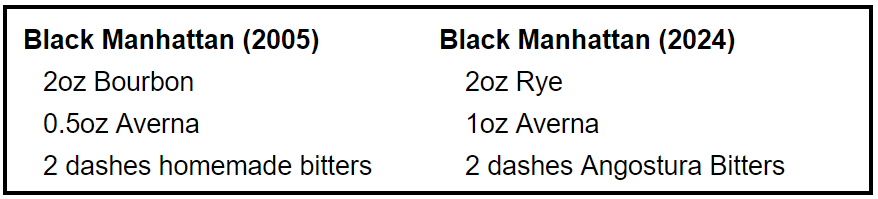
Among most reputable sources, there is consensus that a Black Manhattan today is 2oz Rye Whiskey, 1oz Averna, 2 dashes of bitters. It is, in this way, precisely the standard recipe for a standard Manhattan, just with Averna instead of sweet vermouth.
However: I happen to know that the original Black Manhattan wasn’t that at all. The original 2005 specs for a Black Manhattan were 2oz Bourbon (not rye), 0.5oz Averna (not 1oz) and 2 dashes of a house-made coffee cherry bitters (not Angostura Bitters).
To understand this, it’s worth lingering on how long ago 2005 was in the cocktail world. My favorite time-stamped detail is from a 2007 article in Imbibe called “Rye Whiskey: The Comeback Kid” which quotes Larry Kass of Heaven Hill, producer of Rittenhouse Rye (one of the most popular ryes in the world), and who said at the time, “we spill more bourbon in a day than we sell rye in a year.” Kass estimated that Rittenhouse sold less than 1000 cases a year. Which, if you’re wondering, isn’t much.
Obviously rye has come surging back, and today, everyone knows the Manhattan is a rye drink. In 2005, though, rye simply wasn’t around, so of course a Manhattan would’ve been made with bourbon. What’s more, the whole “vermouth can be delicious” thing hadn’t yet caught on, so even though some forward thinking writers like Gary Regan and Dale DeGroff were calling for 2:1 Manhattans, most bartenders would cut that measurement at least in half. Add in the fad of making your own bitters (something everyone used to do before we all collectively decided to leave it to the professionals), and you have essentially the same Manhattan everyone else would’ve made, but with Averna instead of Sweet Vermouth.
As the Manhattan has changed, so the Black Manhattan has changed. And, I’d say, for the better.
Perfecting the Black Manhattan
Notes on ingredients, one at a time:
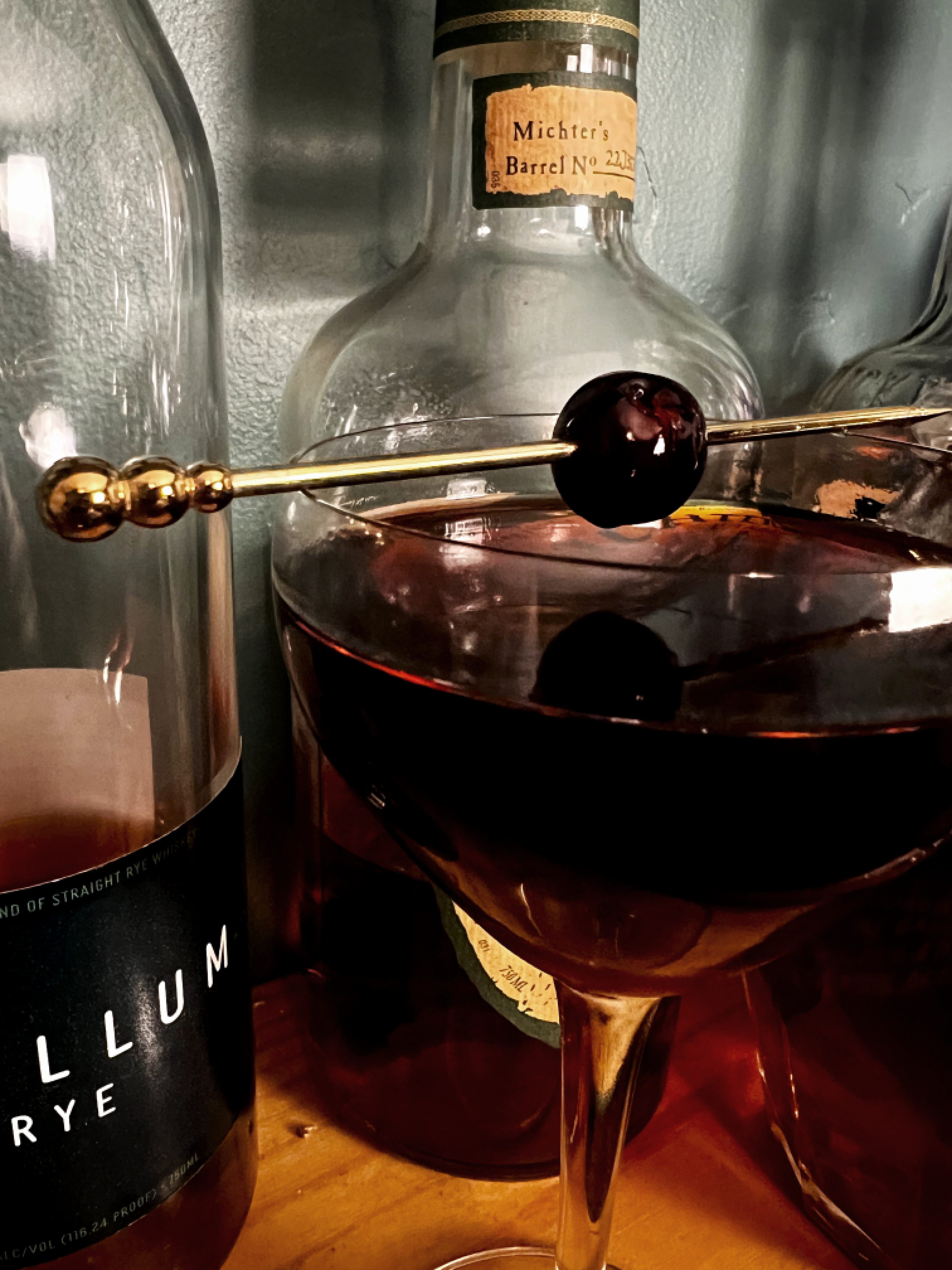
Whiskey: I liked this much better with rye than I did with bourbon. Bourbon reads as louder but also kind of hollow, like two people shouting in a cave — while rye’s seductive spice pairs beautifully with the Averna, bourbon felt like it was competing with it, and not in a good way. As for styles of rye, I don’t have much guidance because I didn’t think any one stood far above the others. I liked it with Rittenhouse, I liked it with Michters (kinda), I liked it with Old Elk and Bulleit and Stellum, high proof, low proof, corn in the mashbill, corn not in the mashbill, whatever. This is just a good drink, use whatever rye you want. The only thing I’ll say is that if the rye is low-ish proof (<90), the sweetness may be a small problem. If so, add a quarter ounce more rye to the recipe, and you’ll be right as rain.
Averna: Let’s be inescapably clear: to make a Black Manhattan, you need Averna. You just do. A whole bunch of otherwise reputable recipes will claim that while Averna is traditional, you can go ahead and substitute it with another Italian amaro (bittersweet liqueur) and you'll be fine. This is incorrect.
While a 4:1 mixture of rye and amaro is delicious with many of them, Averna is the only one I’ve tried — and I’ve tried a bunch — that (1) works with a whole ounce at a ratio of 2:1 and (2) tastes identifiably like a Manhattan. It’s a Manhattan but more so, all the notes big and broad and booming, like they’re being played on a pipe organ. In this task, Averna is singularly talented.
The irony of this is that Averna is among the less-mixable bottles of amaro generally, especially compared to its famous cousins like Cynar, Montenegro, Meletti, Nonino, and others. This is the only famous drink it’s in, and it costs like $40 because you can often only find it in 1L bottles, and so you may hesitate to buy one. I don’t know what to tell you about that. If you want to make a Black Manhattan, you need Averna.
Bitters: As mentioned, Smith was making his own cherry coffee bitters, which he’d make himself and only he knew the recipe for. These are all very 2000s choices, this proprietary bitters thing. It’s easy to make good bitters and very hard to great ones, and the great ones aren’t particularly expensive, so we in the bar world have taken mostly to just buying them.
Lots of online recipes put orange bitters in this. I have no idea why, or where that came from. It’s not bad with orange bitters, but it’s not better. Here, as is true more often than not, a couple dashes of Angostura work just fine, adding spice and depth and still allowing the other ingredients to sing.
The only other thing to note is that when Todd Smith left Bourbon & Branch and the staff couldn’t make his special bitters anymore, they switched to the clove-heavy Fee Brother’s Barrel Aged Old Fashioned Bitters. I don’t like those much so I don’t have them around and therefore didn’t try them in this, but take that for what it’s worth.