
Siesta
Simple, refreshing, bitter, and beautiful.

Generally speaking, the drinks that suffer from too little complexity are vastly outnumbered by the drinks that suffer from too much. Many a young bartender has probed the limits of how many different dashes and drops and barspoons of exotic liqueurs can be festooned on an otherwise simple sour, but it’s an amateur mistake to believe these automatically make it better. Indeed, the most elementally delicious things tend to be the simplest. You could, in this context, think of it like a nap — how many complications are you looking for in a nap?
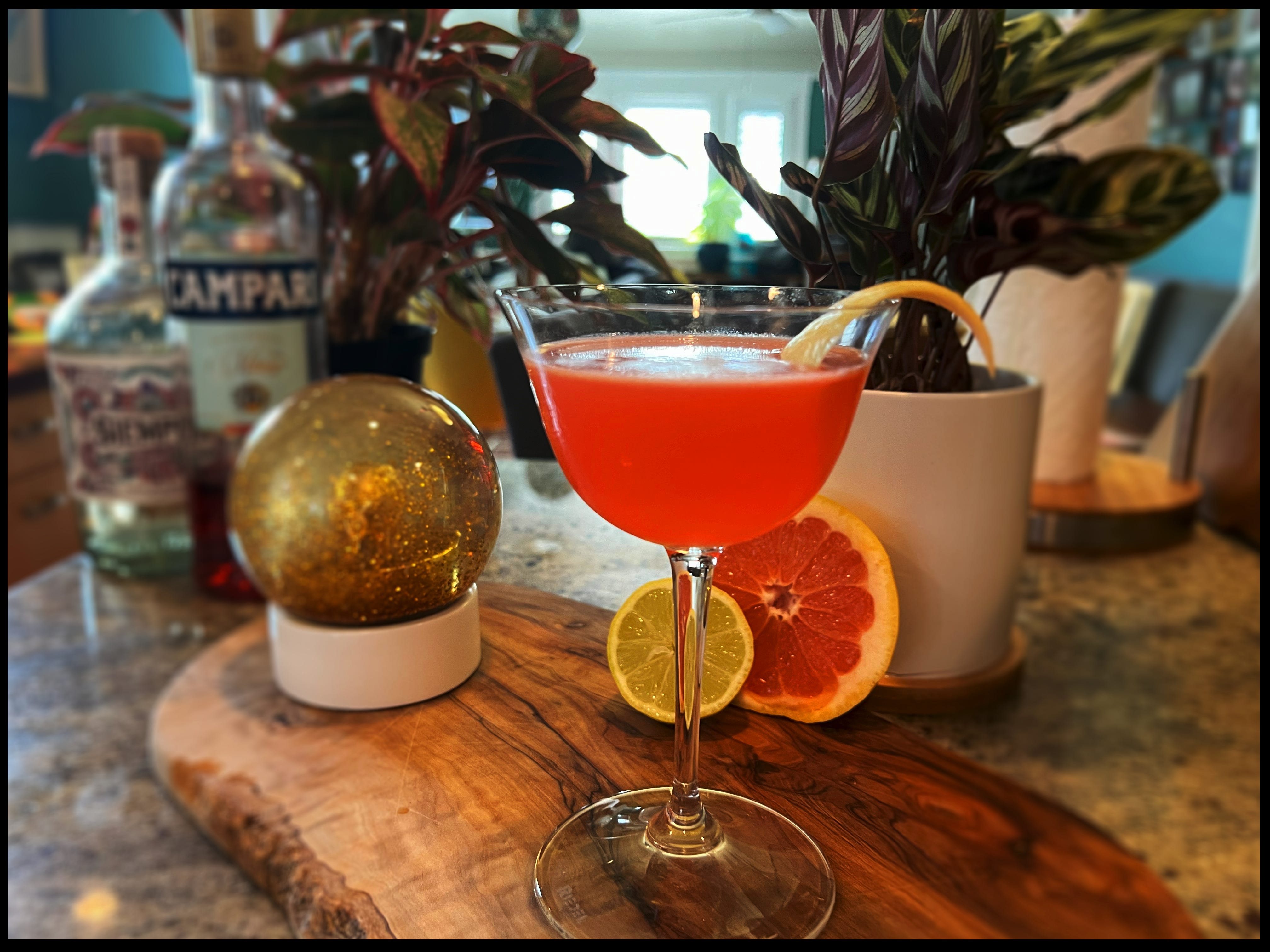
Siesta, at a glance:
Year Created: 2006
Inventor: Katie Stipe
First appears: Flatiron Lounge, NYC
Ingredients: Tequila, Campari, Lime, Grapefruit, Simple
Cocktail Family: Sour
History:
To get a sense of just how much has changed since the Siesta was invented, let’s take a trip back to 2008. For context, Iron Man had just inaugurated the Glowy Thing Cinematic Universe, Katie Perry was just getting famous for singing about Modest Sapphic Urges, and in the world of drinks, Dale DeGroff wrote The Essential Cocktail, wherein he encapsulates a common feeling at the time. In those other contexts 2008 doesn’t feel very long ago, but the following sentence hits my ear as DeGroff were in a dressing gown, writing with a feather by the light of a whale-oil lamp:
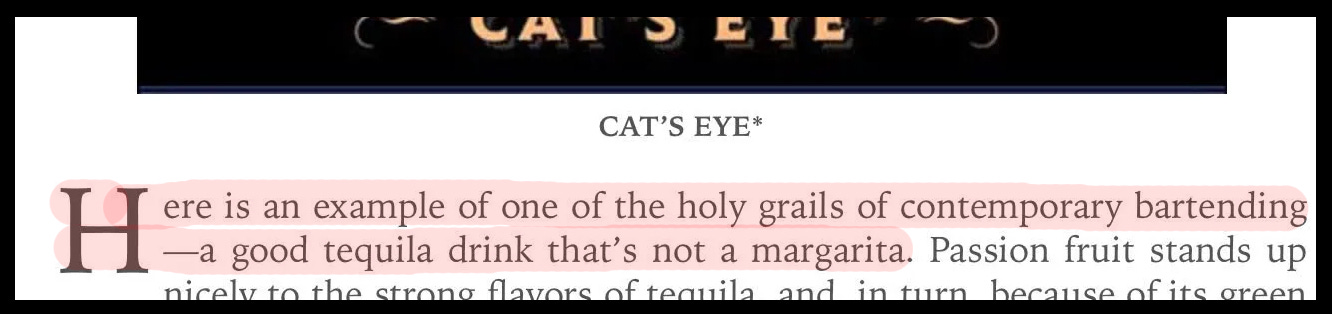
A good tequila drink that wasn’t a Margarita was one of the “holy grails of contemporary bartending” (!!!). Elsewhere, he writes that “it’s an immense challenge for bartenders to find new tequila drinks.” DeGroff is no amateur — he’s the original modern star-tender, a deeply learned and esteemed professional and as responsible as any single human for the cocktail renaissance we all now enjoy — and as recently as 2008, tequila seemed to beguile him. His book has 40+ recipes each with gin, vodka, and whiskey, but only 10 with tequila. Of those, if you ignore the Margaritas, the Long Island Iced Teas, and the Tequila Sunrises, you’re left with a grand total of 3.
I’m not trying to pick on DeGroff, just representing his as an opinion fairly standard for the time. In 2024, of course, this is hilarious: tequila is the most popular spirit in America, and any halfway decent cocktail bartender could feed you a different phenomenal tequila drink, one after another, for as long as you can manage to stay on a stool. So why such a paucity back then? Briefly, because (1) tequila wasn’t exported almost at all when the classic cocktails were being formed (1860s to 1919) so there simply aren’t any tequila cocktails in the classic canon, and (2) the vast majority of the tequila that made it to the US was deeply, deeply shitty. We basically had to learn from scratch how to work with agave spirits, and the early experiments of these drinks were tentative and extremely simple.
The Siesta
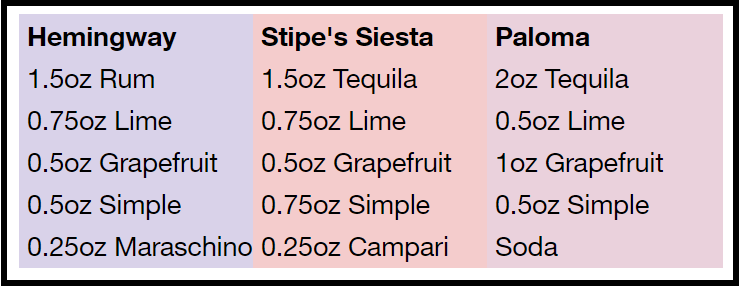
In 2006, Katie Stipe was a fresh-face neophyte at Flatiron Lounge in New York City when she came up with the Siesta. Experientially it feels like a direct take on a Paloma, but Stipe actually got there by way of the Hemingway Daiquiri. She played a little Mr. Potato Head, as we say in bars, swapped the rum for tequila and the maraschino for Campari, and voilà. Magic. It was Stipe’s first cocktail on the Flatiron menu, and became one of the best selling originals in the bar’s history.
Its popularity was helped along by the PDT Cocktail Book in 2011, and once the global bartending competition Speed Rack started promoting it among their Cocktails to Know, it fully graduated to neo-classic. According to Robert Simonson, who has tirelessly documented these things, the Siesta is one of the earliest tequila-based modern classic cocktails we have, behind only the Tommy’s Margarita, from the 90s, and Jacques Bezuidenhout’s (absurdly precocious) La Perla, from 2005.
The Siesta is, as referenced above, extremely simple and straightforward. There’s a mixological itch to fuck with it a bit, to add watermelon or lemongrass or Chareau or kaffir lime leaf or passionfruit or Chartreuse or something. And all of those would almost certainly be good — but if the tequila were washed in coconut oil, would the cocktail have gotten as globally popular as the Siesta ended up? You tend to doubt it. Now, in the modern age, the Siesta seems fairly obvious, but that has nothing whatsoever to do with two main points: (1) it wasn’t obvious at the time, and (2) the most obvious drinks are almost always the most delicious (see: Daiquiri, the).
Perfecting the Siesta:
Notes on ingredients, one at a time:
Tequila: This is a blanco tequila drink. You can use an aged tequila (reposado or anejo) if you have a mind to and it certainly won’t be bad, but it’s how the grapefruit and Campari act as foil for the bright vegetal bite of blanco tequila that’s the real star, here. For brands, as with the Paloma, I don’t want anything too earthy or complex. You obviously need 100% agave tequila and it would be a thrill if it were Additive Free, but I think the super complex sipping blancos actually wouldn’t work as well as the bright, snappy, solid and affordable mixing tequilas, like Real del Valle or Cimarron.
Recipe: I’ve changed Stipe’s recipe only a bit. As mentioned, I’m a big fan of the Siesta, though I admit I’d never put something this simple on a menu in 2024, but this is the cocktail and it deserves to be enjoyed as it was created. The only change I feel comfortable making while respecting vibe of the original is to up the Campari. Stipe’s original called for 0.75oz simple syrup and 0.25oz Campari — just a pinky toe into the world of Campari’s bitterness — but everything is better if you level the two out, at 0.5oz each.
Recipe:
Siesta
1.5 oz. blanco tequila
0.75 oz. lime juice
0.5 oz. grapefruit juice
0.5 oz. simple syrup
0.5 oz. Campari
Add all ingredients to a cocktail shaker with ice and shake good and hard for six to 10 seconds. Strain up into a coupe or cocktail glass, or over fresh ice on the rocks, as you prefer, and garnish with a grapefruit peel or lime wheel.
Trivia:
A siesta is essentially an afternoon nap, which you certainly already knew. But did you know that it comes from the Latin sexta hora, referring to the sixth hour of the day? The ancient Romans kept time by counting the hours from sunrise, not from midnight, so the “sixth hour” was right about noon, when it’s hot and you get sleepy and it’s time to take a little siesta. Didn’t know that, did you, hot shot?
Further Reading:
History/Context: As with any modern classic, Robert Simonson got there first and did it so well, the rest of us just try to find some other angle.
The duo responsible for promoting the Siesta are coming out with a book on April 30, 2024 — A Quick Drink: The Speed Rack Guide to Winning Cocktails For Every Mood. It’s a cool book and it’s for a good cause, and yes of course the Siesta’s in it.